
Our performance was not an incident
Yesterday I went on stage at the Kinky Spring Market with a bold performance — and with music that was equally bold.
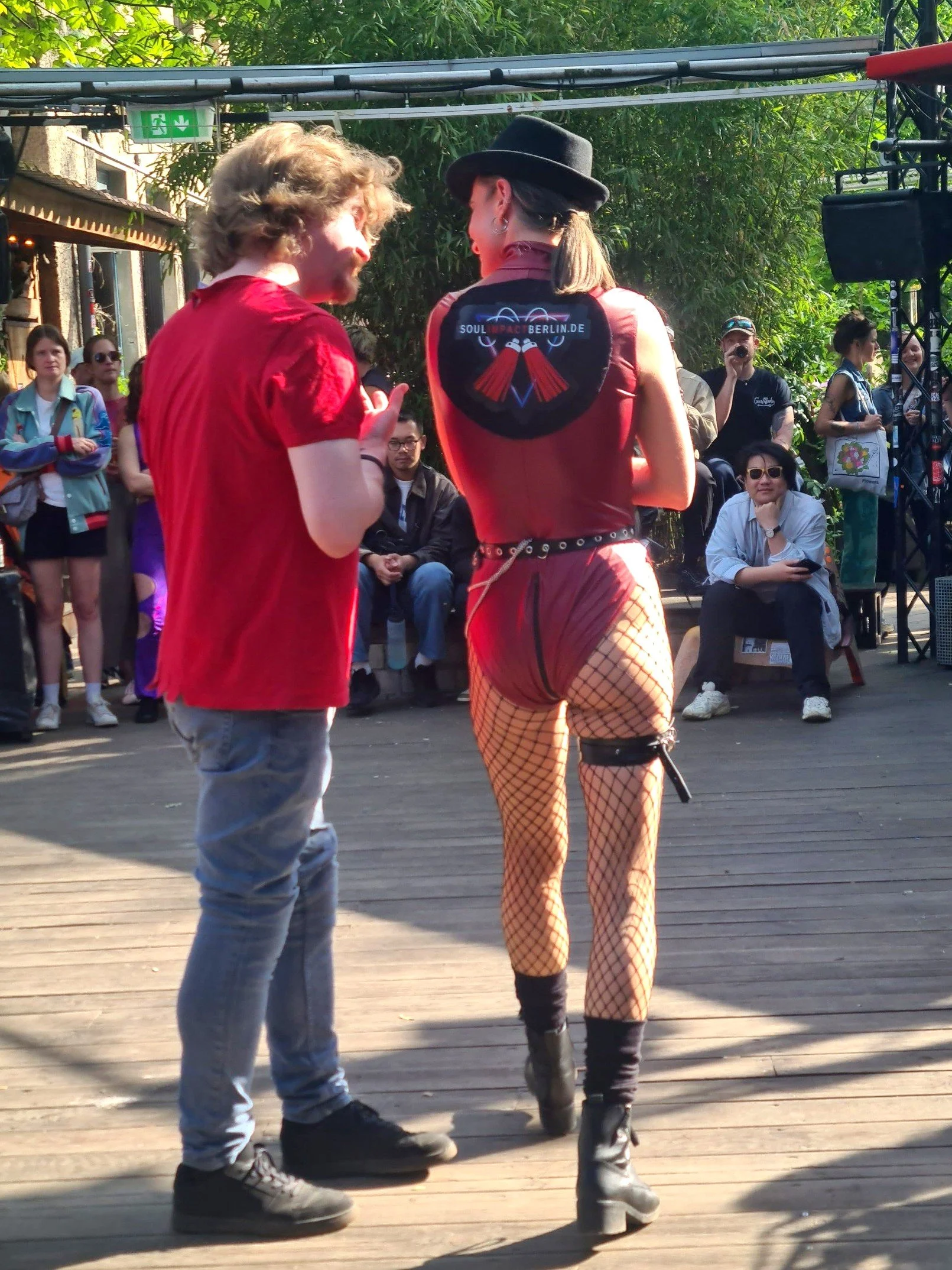
After the performance, a public statement was made about our artistic choices. As I was not given the opportunity to speak for myself at that moment, I want to do so now.
In the performance, my stage partner courted me. I clearly rejected him multiple times, but he continued pushing further until he grabbed my ass. At that point, the dynamic shifted: I turned furious and began punishing him through flogging, whipping, and grabbing.
To be absolutely clear: everything between us was rehearsed beforehand and fully consensual from both sides.
The turning point of the performance was accompanied by a Rammstein song that was intentionally chosen for the theme of the act. Moments later, our music was abruptly cut in the middle of the performance at the instruction of the event promoter/organiser, who later referred to our music choice as an “incident” in a public statement immediately afterward.
And before continuing: if you do not wish to engage with a discussion involving Rammstein, consent, sexual assault, or unwanted touch, please feel free to stop reading here.
I am fully aware of the allegations of sexual assaults surrounding Till Lindemann. Ignoring that context would be dishonest.
But the performance was never intended as admiration, provocation for its own sake, or shock value.
On the surface, yes: I used a Rammstein song in front of a kinky audience. But underneath the surface, the performance told a very different story. It showed a woman being approached by a man who repeatedly ignores her rejection and pushes physical contact further than she wants. The moment that last boundary is crossed, she stops enduring and starts fighting back. She becomes powerful. Violent. Unapologetic.
And that matters.
Still today, too many people — especially women — know the reality of unwanted touch. Especially within kinky spaces, including spaces like the one many people in that audience often go to. Still today, there are so too many environments where we are often expected to stay polite, avoid escalation, smile through discomfort, or prioritize the collective atmosphere over our own boundaries.
What I wanted to put on stage was not the glorification of a man accused of abuse. I wanted to put rage on stage. Female rage. The rage that comes from having your “no” ignored one too many times. Which is precisely what lies at the core of the allegations surrounding that night — and exactly the intention behind the musical choice. If I had been a victim of Till Lindemann — which, to be absolutely clear, I was not — I imagine I would rather watch a woman violently reclaim power from a man who refuses to listen than watch people pretend those dynamics do not exist.
Backstage after the performance, a man told me: “People don’t want to look beyond the surface.”
That sentence made me furious on the inside.
I wondered if he had ever experienced unwanted touch himself. I wondered if he knew what it feels like to endure situations silently because escalating in the moment simply does not feel safe. I wondered if he had ever felt the helpless anger that makes you think: “I wish someone would stop or even hit this person for me.”
It is easy to create a “safe” performance. Something pretty. Something decorative. Something that entertains a kinky crowd for a few minutes between drinks and conversations about new outfits.
But I did not invest weeks of creative energy, rehearsals, emotional vulnerability, and physical work simply to become decoration on a Sunday afternoon on Mother’s Day.
I am not interested in using my body merely to please a crowd. I am interested in using attention to make people think, feel, react, question, and discuss.
And art that touches difficult themes will sometimes make people uncomfortable.
That said: I genuinely regret if hearing the song itself was triggering or painful for some people. Causing harm was never my intention, nor was using the song simply for provocation. My intention was to create 13 minutes that invited people to look deeper — into consent, power, rage, violation, and reclaiming agency. Because, as we can clearly see, these conversations are unfortunately still very much alive within this community.
I also want to thank the people who approached me afterward to express support and to say that they immediately understood the theme. I could not help but notice that these conversations all came from women. It meant a lot to feel that the emotional and political core of the performance reached the people it was intended for.
Kink, to me, has never been about people-pleasing. It is about exploring edges — emotional, psychological, erotic, and social. It is about confronting things that are uncomfortable, complicated, and real so that we can look beyond the surface. This performance had a place on that stage yesterday.
I also do not want to simply move past the fact that an organizer decided to cut the music in the middle of an intense performative moment.
To me, that was not moderation — it was censorship.
The performance was interrupted precisely at the moment where the emotional tension and artistic statement reached their peak. Instead of allowing the audience the autonomy to interpret, react, question, or even disagree with what they were witnessing, the decision was made for them.
To make matters worse, in the statement following the performance, our artistic decision was publicly labelled an “incident.” In that moment, the performance was stripped of its intention and context. The audience was encouraged to view what happened not as a piece of performative and musical storytelling open to interpretation, but as a mistake, a disruption, or a problem that needed to be managed.
People are absolutely free to dislike my artistic choice. They are free to criticize it, challenge it, or condemn it. I welcome those conversations. In fact, I want us to have difficult discussions about consent, escalation, boundaries, and unwanted touch within our own communities. Because if those discussions happen, then I believe the performance achieved something meaningful. With or without Rammstein.
In the future, I will continue using performance not to provoke for the sake of provocation, nor to passively entertain, but to create reflection and emotional movement about topics that matter to me.
And if that is not what you are looking for from performance art, that is completely okay too.
Just don’t come to my performances.