
Finger Flogging - let’s get started!
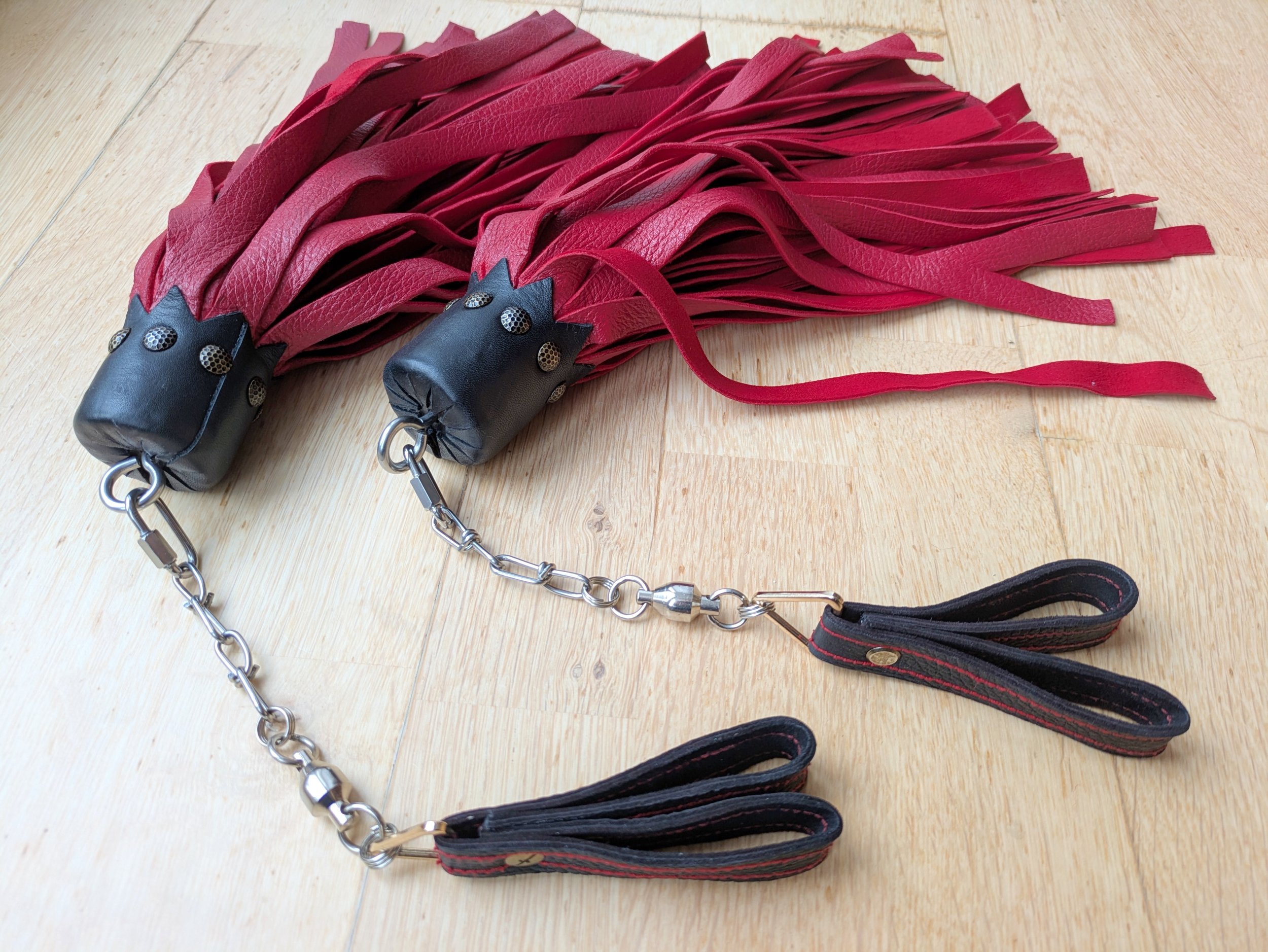
Finger floggers open up a whole new pathway into impact sensation compared to handled floggers, as I have already mentioned on my blog (along with where to get them in Berlin). If you’ve always wanted to learn but never quite got the chance—this is your starting point. Just don’t forget: finger floggers come with a learning curve. You have to practice to get good at them. It means more practice—but also, in the end, a lot more fun than with handled floggers. This guide is intended to get you started learning them.
If you’re not the “learn from YouTube” kind of person, and you’d like to ask questions live, and have your movements corrected when needed—come to my workshop 😉
This guide (and honestly, a big part of building my own skills) relies heavily on D & M’s aka FlogandFlow tutorials and videos. Go check out their website and YouTube channel—and while you’re there, like, subscribe, share the love.
What sets finger floggers apart from handled floggers
First, let’s bust a myth. Very recently I demoed finger floggers for a very experienced masochist. She said it looks “sweet”. So I took to Rosie, and within 10–15 strokes on the same spot she called orange. I wasn’t even out of breath yet. Then I switched to Margaret Thatcher—and within another 6-8 strokes, she moved from her position. She looked at me and went: “Alright. I take it back. They are evil.”
Finger floggers are sneaky beasts.
They’re small, friendly-looking, and seem almost harmless next to heavy handled floggers. But with the right technique, they can be just as intense as their more “serious-looking” counterparts. The key is gradual buildup and good technique.
But that’s only part of the story.
What I love about finger floggers is that they allow for a much more full-body experience. Because they start soft, I can gently warm up areas that would usually be off-limits—like along the spine or (gently) even the kidneys—without compromising safety. I can wake up the whole body before an impact scene even begins. And they do this without much technique - you don’t need to do a reverse four-point florentine to use them. The basic - forward/backward circlular strike will get you far in any session.
Having said that, finger floggers are incredibly sensitive to technique, so you need to learn them to use the full spectrum of sensiations they offer. Using just the tips creates a completely different sensation than using the full fall of the flogger—which becomes much more thuddy. I can work symmetrically on the body, split impact zones (one on the back, one on the butt), or play with opposing directions—one upward, one downward—to gently confuse the mind and pull someone deeper into body space. I can double up, holding two in each hand for added weight and intensity. I need less space, which means I can almost always find a corner at a party to flog. I can follow rhythm, play with tempo, sync to music—and suddenly the whole thing becomes not just impact, but a full sensory experience.
Also: let’s be honest. Finger flogging is very hard to ignore at any party. People watch. People get curious. Conversations happen.
And once you have the basics down—there’s no real limit to what you can create.
All it takes is practice.
And practice.
And then… a bit more practice.
A little bit of history
Finger flogging has its roots in poi, a practice originating with the Māori people of Aotearoa (New Zealand). Traditionally, poi were used as tools for developing coordination, rhythm, and strength—often involving weighted balls on cords swung in patterned movements. Over time, poi evolved into both performance art and flow practice, with increasingly complex patterns, direction changes, and multi-object coordination.
A lot of what we do in finger flogging—especially Florentine patterns, directional changes, and flow-based movement—comes directly from poi. If you ever feel stuck or want inspiration, looking into poi tutorials can open up a whole new world of ideas.
Keep this in mind
The holy grail of finger flogging is accuracy.
I cannot emphasize this enough: you need to train your hands to land exactly where your eyes are looking—and not just in 2D, but in full 3D awareness, so depth. A difference of a few centimeters can mean hitting a completely different (and unintended) body part.
This becomes especially important when working near sensitive areas, such as the genitals, so watch this video.
Precision is what turns finger flogging from “random swinging” into intentional, controlled impact.
Here I will link a few videos and propose a learning path for you to get into the practice. You can also use this guide as a catchup with workshop material, or as a way to learn new, more complex moves. Have fun!
Basic technique
You can go a long way with solid basics. Start with one-handed movements: forward, backward, and cross-body patterns. Then move into two-handed versions. From there, learn how to change spin direction cleanly. D & M have excellent demonstrations of all of these—use them.
I suggest starting to flog and learn the movements in the air, and when that works, you can switch to flogging the wall. If you have that under control, then you already know enough to start practicing on a person.
Intermediate technique
Once the basics live in your muscles, it’s time for the six-point Florentine. Then the reversed version. These are more complicated moves, but with practice they will click. Take you time. Pro-tip: close your eyes, sometimes it’s easier to learn a new movement without visual feedback.
If all goes well, this is where things start to feel like flow instead of effort.
Advanced stuff
Honestly—once you’re comfortable with Florentine, you’re ready to start inventing your own moves.
If you want inspiration, try layering different patterns in each hand. For example: sideswipes in one hand, Florentine in the other. Or play with angles—same movement, different landing points on the body.
Personally, I love redirecting off my own body (because yes—I like receiving too). It creates entirely new pathways and rebound angles that lead to unexpected, beautiful movements. Play, be creative, have fun, and you’ll inevitably find your personal style. That’s the beauty of this art: once you have solid basics, you can just enjoy it and develop your own way of finger flogging.
The good news
Once you’ve built up your finger flogging skills, you can transfer a lot of them to handled floggers—yes, even Florentine patterns.
But the real beauty of finger floggers?
They’re not just kinky tools.
They’re a way to train attention, coordination, and creativity. You can practice between meetings while at home office, while your lunch is cooking, or just put on your favorite music to play in the background when you practice and wind off in the evening. If you start syncing your movement to rhythm and intensity, your skills (and your motivation) will grow fast.
And then—take it out into the world.
If you want to see what it can look like, then see the Rockstars of Finger Flogging in action:
https://www.instagram.com/flogandflow/