
A Very Subjective Guide to Choosing a Flogger
I get asked about this topic a lot, so here it is: my very subjective guide to choosing a precious (and often expensive) flogger.
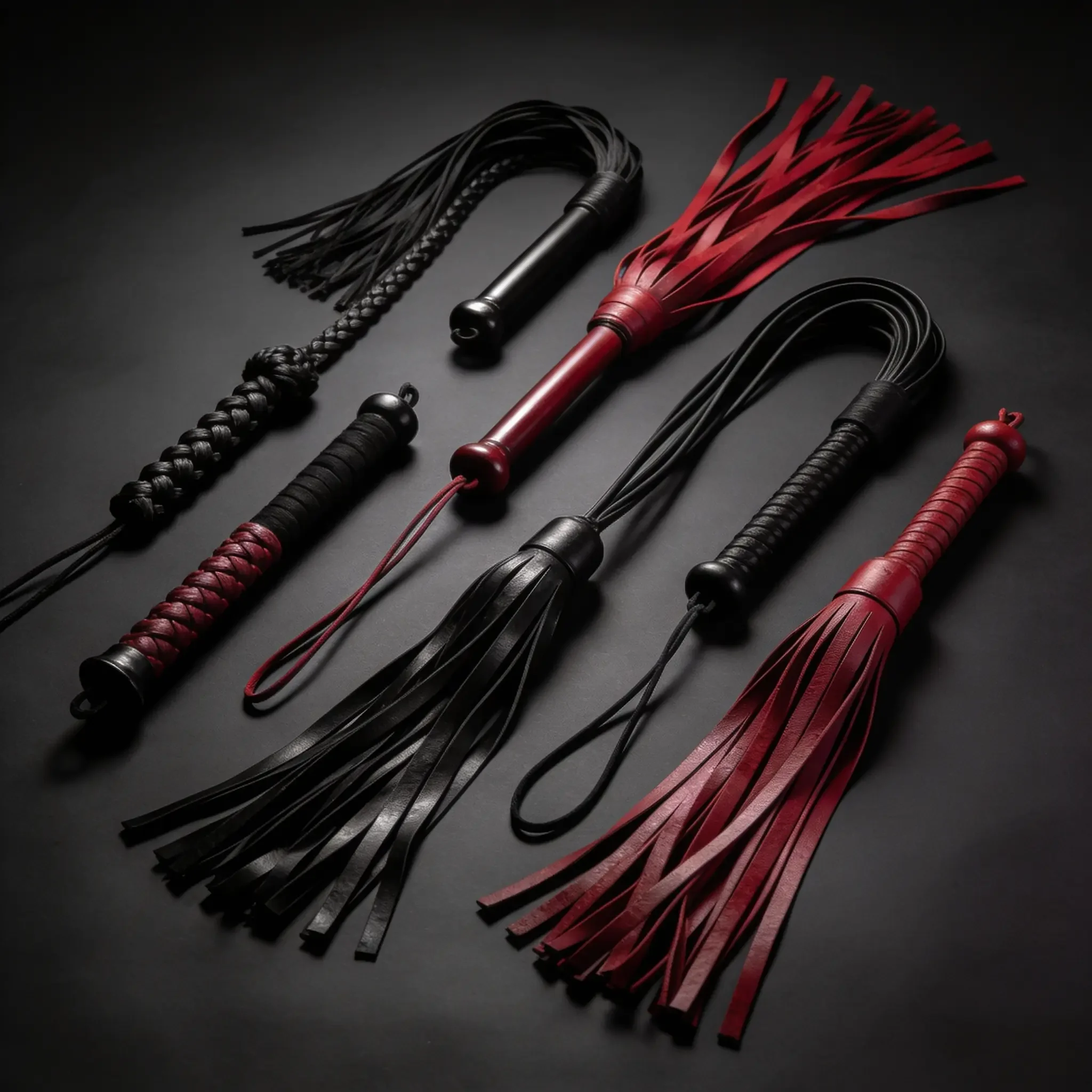
I mostly work with floggers. So I won’t go into whips, canes, or paddles here. Each of those would deserve an article of their own.
Where to start
When someone asks me for advice, the first question I usually ask back is: what do you want the flogger for? What kind of impact do you enjoy delivering — and what is it that your receivers are asking for?
If you don’t know yet, that’s completely fine. No one does in the beginning.
In that case, I usually recommend starting with something fairly “universal.” My very first flogger was a second-hand piece from eBay, cost 25 euros, and it’s still one of my most-used tools. It has falls of about 55 cm and a handle of roughly 20 cm, which makes it surprisingly versatile (note that I am 178 cm tall, so what feels comfortable for me might be too long for shorter people). I can work with just the tips for sharper sensations, or bring in more surface for broader impact. It’s long enough for body wrapping, but not so long that aiming becomes difficult.
It’s soft (and hairy) enough to help build that first layer of trust, but if I hold out before the hit, the falls concentrate enough to deliver a solid, confident strike. Even years later, it still does a lot of work for me.
What to consider
Length
In general, shorter floggers are easier to aim with, but they’re usually unsuitable for body wrapping. Longer floggers really shine when it comes to wrapping and, once you’ve learned how to control timing and hold-out, they become extremely versatile — capable of delivering anything from very gentle to very intense sensations.
There’s no “better” length here. It’s about what fits your body, your reach, and your skill level.
What actually determines the sensation
What a flogger feels like on the body has much less to do with marketing descriptions than with a few simple physical factors: the thickness and width of the falls, and how soft or hard the material is.
Wider falls generally create deeper, more thuddy sensations. Thinner falls almost always feel stingier, regardless of the material. The type of leather or other material fine-tunes this, but it doesn’t override basic mechanics.
Suede (unfinished) leather tends to be softer while still firm, but it’s also the hardest to clean. Compared to finished leather, it’s the first to start coming apart, developing rough edges and uneven surfaces over time. This doesn’t make it unusable, but it does make it less durable and more demanding in terms of care.
Materials: does it have to be leather?
No — it doesn’t have to be leather. That said, most of my floggers are leather, and that’s a deliberate choice.
I generally avoid breaking skin, mainly because I don’t want blood on my tools. Some materials are clearly designed to do exactly that: chain floggers, for example, will draw blood very quickly. If that’s what you want, that’s fine — just make sure you contain blood drops for safety reasons (so chain floggers are for example not suitable for public play).
I do have a few rubber floggers, and they are nasty in their own way. If you prepare the skin very well — think 30+ minutes of warm-up — they can deliver intense sensations without breaking skin. On unprepared skin, they’re excellent for leaving marks (and to potentially open the skin…). Smaller rubber floggers are also useful for genital play, since they can be cleaned thoroughly with soap + water + air-drying right after the session, or for silicon-based floggers: with boiling hot water.
Rope-based floggers make me uneasy simply because they’re hard to clean properly. Vegan-leather or plastic floggers can be decent options; there’s always a small risk of plastic particles under very hard use, but they do have the advantage of being easy to keep clean. Hair floggers — especially horsehair — are a special case: skin-friendly, cleanable, and surprisingly versatile depending on how you use them.
Since almost anything can be turned into a flogger, my general advice is to pay close attention to cleanliness and cleanability — and to always try a new tool on yourself before using it on someone else. The world is full of surprises.
Building a repertoire (not a collection)
It’s very easy to give in to temptation and bulk-shop floggers. If this weren’t my job, I’d probably be perfectly happy with about five — okay, maybe two or three additional impulse purchases.
What matters much more than quantity is familiarity. Knowing how a flogger sits in your hand, how it moves, and which ones feel “like you” when you use them.
Instead of building sets, focus on building skills (see the workshops). Learn how much range you can get out of a single flogger: using the tips for stingy sensations, striking from the side to land more surface, letting the same tool move between sharp impact and deep, almost massage-like thud. Once you can really bring out that versatility, it becomes obvious what’s missing. Your receivers will usually let you know — sometimes very clearly — and then you’ll know exactly what you’re looking for next.
What you can safely ignore
Over the years, I’ve read a lot of flogger descriptions, both online and in shops, and my general impression is that floggers are often much less different from each other than marketing suggests.
One example is tip cutting. Square versus arrow-shaped tips only make a noticeable difference if you’re delivering sensation almost exclusively with the very ends — and even then, we’re talking about maybe a 10–20 % change in intensity. As soon as more of the flogger lands on the body, that difference mostly disappears. It’s basic mechanics.
The same goes for leather type. Mechanics don’t care about the animal, only about softness and hardness. Deer leather is often soft, cow leather often harder — but there are plenty of exceptions. How the leather feels (i.e. how hard or rigid it is) matters far more than what it’s called.
Making your own flogger
People often ask whether it’s worth making floggers themselves. In my experience, it’s harder and more expensive than it looks.
The leather itself isn’t the main issue — you can get a decent piece for 20–30 euros. The real costs come from the tools, the techniques, and the many mistakes you’ll inevitably make at the beginning. Then there’s the hardware, the construction details, and, not least, safety. When I buy a flogger, I like to think that I’m outsourcing a large part of that responsibility to an experienced maker and trusting their knowledge.
If cost is your main concern, buying used floggers is a perfectly valid option. Just clean them first — and keep cleaning them while you use them.
A note on finger floggers
Finger floggers deserve special mention (of course, I am biased). But they have a few extra perks to look out for when shopping: the market is smaller (so there is less experience available), the hardware is harder to get right for quality, and the comfort of the loop can make or break the experience much more dramatically than handle shape does with a traditional flogger. That is on top of the leather qualities and all the other points that are valid for floggers in general.
Luckily, there’s an excellent guide by Flog & Flow on what to look out for when buying finger floggers, which I highly recommend reading.
One personal addition: when you’re learning, finger floggers of around 200 g per piece tend to be much more comfortable and controllable.
Where to buy
Before we start, a short disclaimer: I get absolutely no commission from any of the vendors mentioned here. These are honest recommendations based on my own experience — which also means I’m biased toward the floggers I’ve bought and used. Please still do your own research before committing.
Most of my floggers (and some of their names…) come from Sadistens Toolbox in Denmark. Dan used to sell on Etsy in English, but those times are gone. What I really like about his work is the handle design — slightly rubbery, so it doesn’t slip — and the way he describes floggers by their effect on the skin rather than just their materials, making the buying decision easier. His descriptions are surprisingly accurate in practice.
I’ve also bought a few pieces from StarlingGB, and I’ve been very happy with the price–quality balance.
I got my wonderful snake whips from PPleathershop, I am very happy with their quality. My infamous cat-o-nine comes from this shop, and both of my whips. I find them less soft, therefore easier to aim with than other single tails on the market. However, they don’t wrap around the body as smoothly as the other whips, so again, the choice depends on what you’d like to use them for.
Some of my rubber floggers come from PeitschenbaerShop. They are a great source if you’re looking for cleanable instruments, i.e. to flog genitalia or even to do a bloody session, if that’s your thing.
And then, of course, the most important opportunity and shop for impact tools is McHurt in Berlin. They carry far more floggers, whips, paddles and canes than what’s listed on their website — and often better quality than you might expect from the online shop alone. If you’re considering buying, they are absolutely worth a visit. They also give genuinely useful advice about which tools make sense for your intended use case.
Finger floggers are much trickier to get. Luckily, in February 2026 Steffen from Zuckerbrod in Berlin began making them, taking both the aesthetics and the mechanics to a whole new level. I can honestly — and without any interest or commission — warmly recommend trying his finger floggers. They stand out for their quality, ease of use, and durability.
The photo here shows some of his very first prototypes, taken right on his workbench in the workshop. I hope you can still sense a bit of that fresh-from-the-maker warmth in them.
Other than that, I can safely recommend Whips By Wolf from the Netherlands. Time to time they come to events in Germany and sell their floggers. Flog & Flow kindly compiled a list of infamous vendors of finger floggers, that you can rely on (from this article), although that’s a USA perspective on the market.
I’m always happy to hear feedback and vendor recommendations — the good, the bad and the ugly.
Once you invested in a good flogger (or two), what’s the next step? That’s right, storing and cleaning it the right way.