
THE GATE THEORY OF PAIN I: The Multidimensional Experience
This is the first article in a series on the Gate Control Theory of Pain — a cornerstone theory published in the 1960s that still plays a crucial role in how we understand pain processing. It rests on an idea that seems counterintuitive at first: sensation (as picked up by receptors in the skin) and the experience of pain (constructed by the central nervous system) are independent processes.
In this part, we'll take a closer look at the journey of the signal and its context. In part two, we'll explore the time dimension of the pain response, and in part three, we'll dig into the neuropsychology behind the experience.
Have you ever hurt yourself and only noticed the pain minutes or even hours later? Or had a headache, even though the brain has no pain receptors? Or felt pain in one part of the body even though the actual injury occurred elsewhere? These are just a few examples that intuitively tell as that physical injury and the subjective experience of pain are not always directly related.
This distinction is at the heart of Melzack and Wall’s Gate Control Theory of Pain, first published in 1965. Their revolutionary model helped explain why pain is not simply a direct response to tissue damage but a complex, dynamic process involving both bottom-up sensory input and top-down modulation from the brain. The theory remains foundational in pain science today, and provides a useful framework for managing pain in impact play.
Pain Is Not Just Physical
Pain is not a linear reaction to injury; it's a multidimensional experience shaped by culture, learning, attention, context and emotional state. Anxiety, for example, increases pain perception—negative anticipation (fear) can make a mild sensation feel sharper. In contrast, relaxation or distraction can significantly reduce the sensation of pain - this is the secret behind the pain-reducing capabilities of your mum’s kiss… As with most things there are exeptions to this rule - some people like the thrill of fear in impact play - but in my experience this is relatively rare.
Even the perception of control plays a powerful role. In a classic experiment (Mowrer & Viek, 1948), rats were exposed to electric shocks (the ethical standard of scientific experimenting were not nearly at the level they are nowdays…). One group of rats could end the shock by jumping, while the other had no control over its duration. Although both received the same amount of shock, the rats who had control were less stressed and continued normal behaviors like eating. This illustrates that our nervous system reacts not only to stimuli but also to how we interpret and engage with those stimuli. It's one more reason to have a well-developed system of breaks (and/or a safeword) in place during play — the person always has to be, and feel, in control of their experience. Because they should be. And it increases the level of sensation they therefore choose to take!
The Gate Control Theory Explained
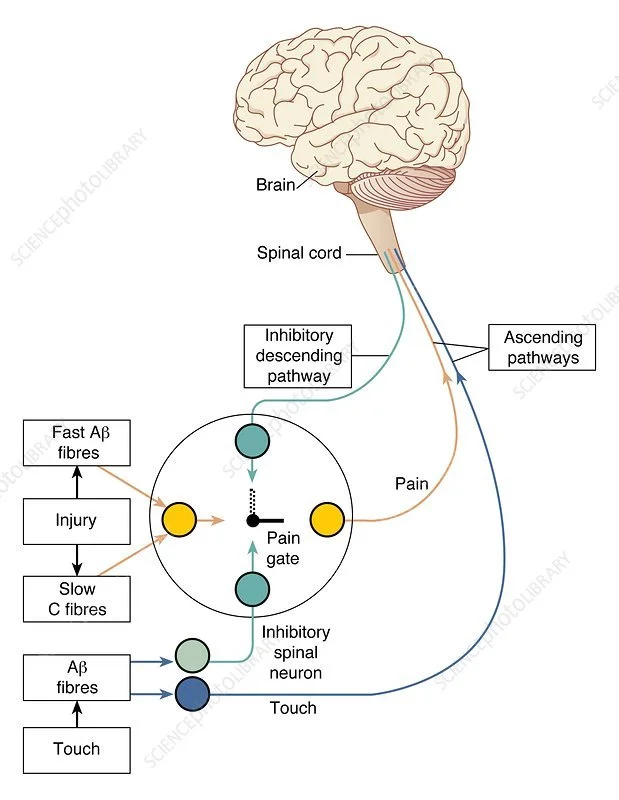
Gate Control Theory Of Pain, Artwork is a photograph by Science Photo Library
https://fineartamerica.com/featured/gate-control-theory-of-pain-artwork-peter-gardiner.html
Melzack and Wall proposed that pain signals from the body must pass through a kind of "gate" in the spinal cord, which can either amplify or dampen the signal before it reaches the brain. This gate is influenced by various factors:
Sensory input (e.g., touch, pressure and warmth)
Emotional and cognitive context (e.g., safety, fear, attention, meaning)
Descending signals from the brain (e.g., expectations, memories)
When you receive an impact, your nociceptors—the sensory neurons that detect harmful stimuli—start firing rapidly. But whether you interpret that signal as painful depends on what happens next, as it passes through various processing centers in the central nervous system. There is no single "pain center" in the brain; instead, the signal travels through and receives input from multiple regions: the limbic system (emotion), the hippocampus (memory), the amygdala (fear/avoidance), and the frontal lobe (context, meaning, intention). These inputs and outputs are integrated in a split second, allowing the body to decide how to respond to the incoming signal.
Interestingly, this involvement of the frontal lobe explains why many animals react to pain reflexively—by fleeing. Animals have a much less developed frontal lobe than humans, so they typically respond to pain with reflexive avoidance rather than deliberation. Humans, on the other hand, can override that impulse—for instance, when pain is meaningful, consensual, or ritualized—simply because we have a relatively large, well-developed frontal lobe.
Pain perception is a time-sensitive act, because nociception changes over time, which is key in building up the impact journey - this is how this series of articles on the Gate Theory of Pain continues.