
From Sting to Thud: The Neuroscience of pain types
Have you ever seen Jesus?
If not, try this first, before you read any further (navigate to the Jesus image or pick a simplier one). You stare at a strange, high-contrast black-and-white image for 30 seconds, then it automatically disappears, and suddenly something else appears...
This is called the “negative afterimage” illusion, described more in detail here.
If you want the brief version of the neurobiology behind the illusion: The light-sensitive cells in your retina adapt to whatever they're looking at. Normally, tiny constant eye movements keep them fresh. But when you hold your gaze still, the cells looking at the bright areas get overstimulated and lose sensitivity. When you then look at a neutral surface, those tired cells fire more weakly than their rested neighbors. Your brain reads the difference as an image, with light and dark flipped. So a "negative" picture turns back into a positive one: a bearded face with long hair. (Blinking helps refresh the image, and it fades within seconds as the cells recover.)
Something similar happens in impact play when you starty varying the sensations for the receiver. Because nociceptors differ in the sensation they “like to pick up”, they also get tired and oversensitive. If you give them a break by stimulating other kind of receptors (which, on the other hand will be rested and more “hungry” for input), they recover and ready for the battle again. This is why you can prolong a pain journey by alternating inputs.
Not All Nociceptors Speak the Same Language
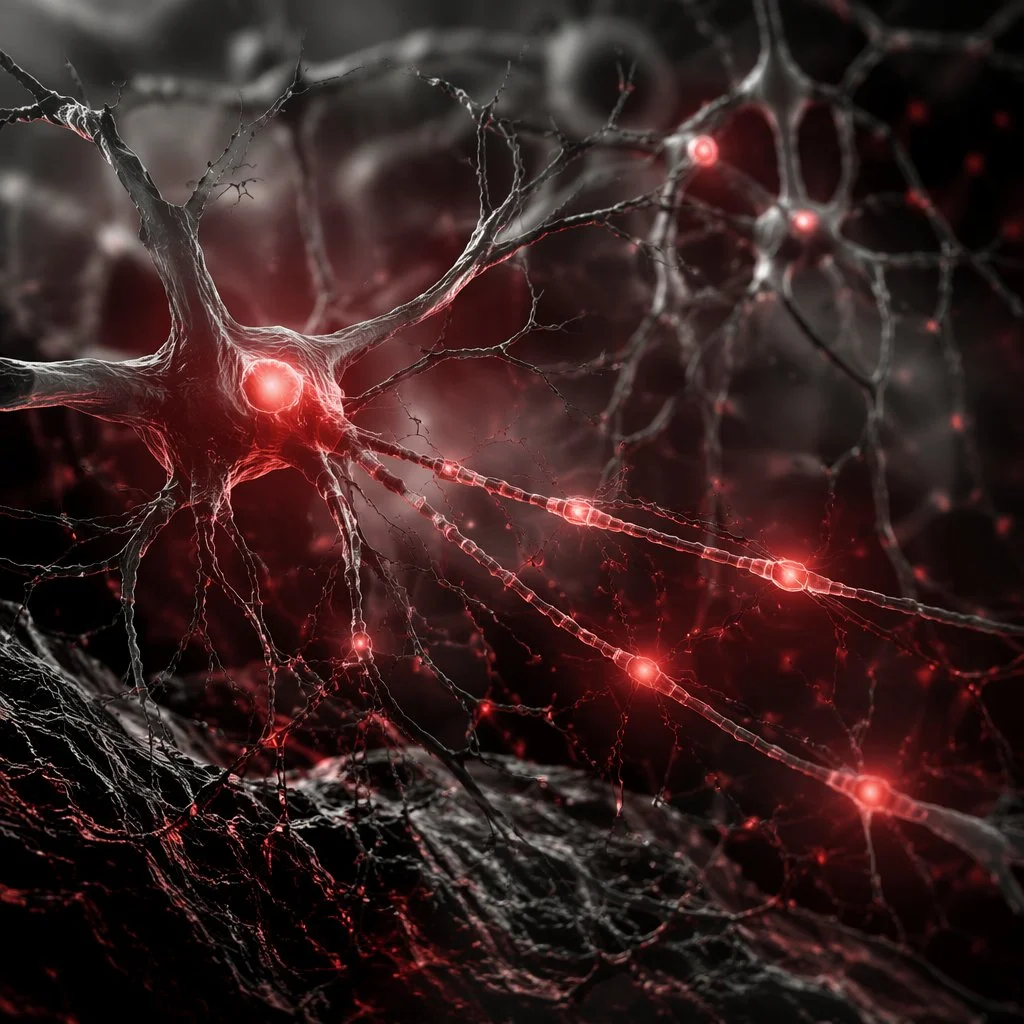
Nociceptors are specialised nerve endings that detect potentially harmful stimuli—but different nociceptors respond to different kinds of input. The experience we describe as sting or thud is not created by a single receptor. It is a pattern—a combination of many signals arriving at the nervous system. The reason for this effect lies partially in highly specialised sensation receptors underneath the skin. These are by large the following:
| Receptor type |
Detects |
Impact play connection |
|---|---|---|
| Mechanical nociceptors |
|
|
| Thermal nociceptors |
|
|
| Polymodal nociceptors |
|
|
| Silent nociceptors |
|
|
| Low-threshold mechanoreceptors |
|
|
| Deep mechanoreceptors |
|
|
Note: "stingy" and "thuddy" are not separate receptor categories. They are subjective descriptions emerging from different combinations of receptor activation, nerve fibre signalling, tissue mechanics and brain interpretation.
Why Switching Tools and Techniques Changes the Experience
Therefore changing the type of stimulation can make a scene feel different, even when the overall intensity remains high. A series of sharp cane strikes trigger a particular pattern of mechanical stimulation. Switching to a “thuddier” flogger changes the sensory input: the pressure is distributed differently, more receptors are involved, and deeper tissues may contribute more strongly to the sensation.
The nervous system receives new information instead of simply more of the same. And it ultimately gives a break to certain types of receptors while engaging new ones.
This is also why alternating between impact, touch by hand, temperature play and massage can create a richer experience. Different forms of stimulation engage partially different sensory pathways and allow previously activated systems to recover and adapt. So next time you “overdid” on your receiver, then give them a massage. It allows for the “overworked” receptors to recover while keeping the two of you in gentle contact. Then let the fun continue!
The Skin Is Only the Beginning
Of course, receptors are only the first step. As discussed previously, the brain does not simply read these signals like a measuring device. It interprets them through the context of the experience: anticipation, trust, attention, emotional state and perceived safety.
Understanding the biology of sensation reveals just how much complexity is involved in processing pain : every tool, every rhythm and every touch creates a different conversation with the nervous system.